


Northeast Average Commodity Value Continues to Increase Despite PET’s Sharp Drop in Q2 2026
NERC’s Material Recovery Facilities (MRF) Commodity Values Survey Report for April – June 2026 reflects the continuing rise of commodity values across the Northeast after several quarters of decline. Dual stream/source-separated MRFs continued to report higher average commodity values than single stream MRFs.
The average blended commodity value increased by 11.1% to $93.03 per ton without residuals and by 15.24% to $76.37 per ton with residuals in Q2 2026 compared to Q1 2026. Single stream values increased by 12.3% to $91.28 per ton without residuals and by 11.37% to $74.74 per ton with residuals. Dual stream values increased by 8.04% to $98.65 per ton without residuals and by 28.33% to $81.62 per ton with residuals.
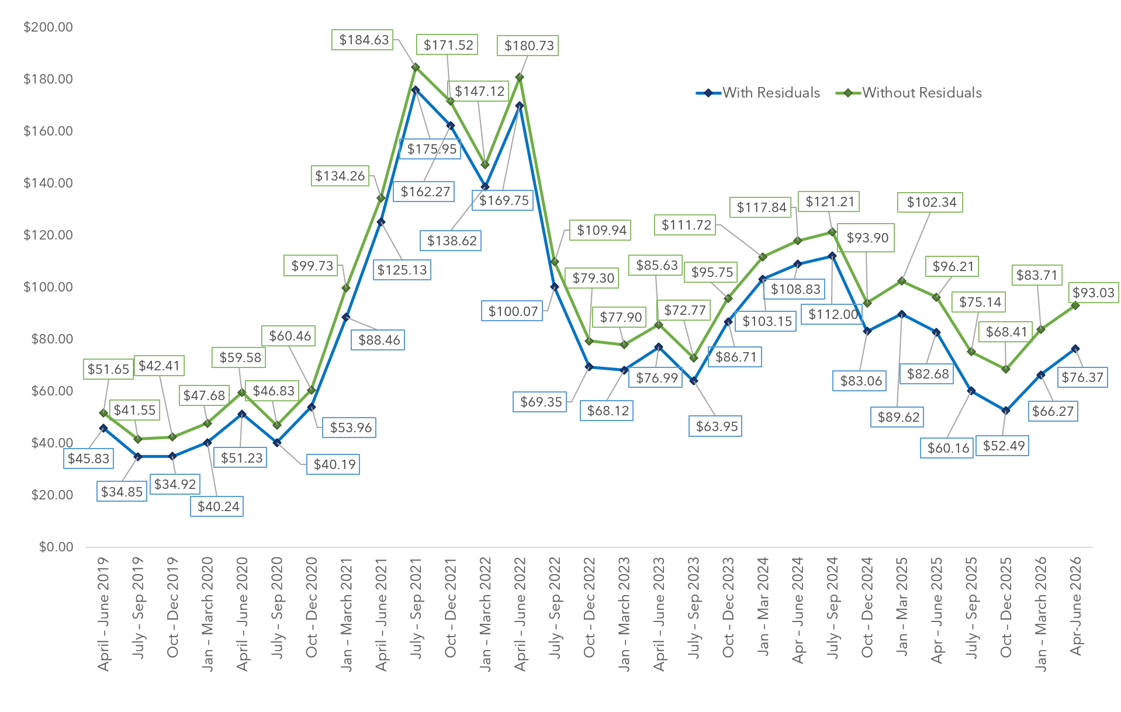
Individual commodities had higher prices during the quarter, except for Polyethylene Terephthalate (PET), Mixed Paper, and Glass – most markedly PET with a 61% decrease. Residue costs also increased during the quarter, making disposal more expensive. Participating MRFs may calculate residue costs differently.
This is the 29th quarterly report in NERC’s ongoing series examining the market value of commodities marketed by MRFs in the Northeast. The report includes data from 19 MRFs representing twelve states: Connecticut, Delaware, Maine, Maryland, Massachusetts, New Hampshire, New Jersey, New York, Pennsylvania, Rhode Island, Vermont, and Virginia.
These survey results reflect the varying laws and collection systems among participating states. Five of the states included in the report have beverage container deposit laws, resulting in fewer glass bottles, PET bottles, and aluminum cans being processed at MRFs in those states. Consequently, those facilities are likely to generate less revenue from those materials.
The report also reflects a mix of single stream, dual stream, and source-separated recycling systems, with single stream remaining the most common collection approach. Collection method impacts both MRF design and operations, meaning the data reflects the unique blend of facility types, statewide policies, and market access across the reporting region.
Residual refers to incoming material that cannot be marketed and must be disposed of. Values reported without residuals reflect the value of a perfect ton of marketed material, while values reported with residuals reflect the value of each ton processed after accounting for disposal costs associated with unmarketable material. In many cases, recovered glass is marketed at a negative value.
This data is not intended to serve as a price guide for MRF contracts. NERC’s database includes both single and dual stream MRFs, states with and without beverage container deposit laws, varying geographic access to markets, and differing material collection programs. As a result, the report reflects a broad diversity of operating conditions and should not be used as a pricing benchmark for any specific recycling program.
For more information, contact Megan Schulz-Fontes, Executive Director, at
megan@nerc.org.
Share Post