
Northeast Glass Recycling Data Highlights Opportunities to Increase Recovery and Circularity
New report identifies leading state programs and opportunities to strengthen glass collection, recycling, and end-market development across the Northeast.
Brattleboro, VT – The Northeast Recycling Council (NERC) has released the Northeast Flow of Glass Report, a regional analysis examining glass container generation, collection, recycling, disposal, policies, and end markets across the eleven Northeast states. Building on NERC's previous research into glass recovery, processing, and end markets, the report provides a comprehensive snapshot of how glass moves through the Northeast materials management system and identifies opportunities to strengthen glass recycling through policy, infrastructure investment, and market development.
Key Findings from the Northeast Flow of Glass Report
- Vermont (79.9%) and Connecticut (77.0%) recycled the highest share of glass containers relative to total glass container waste generated.
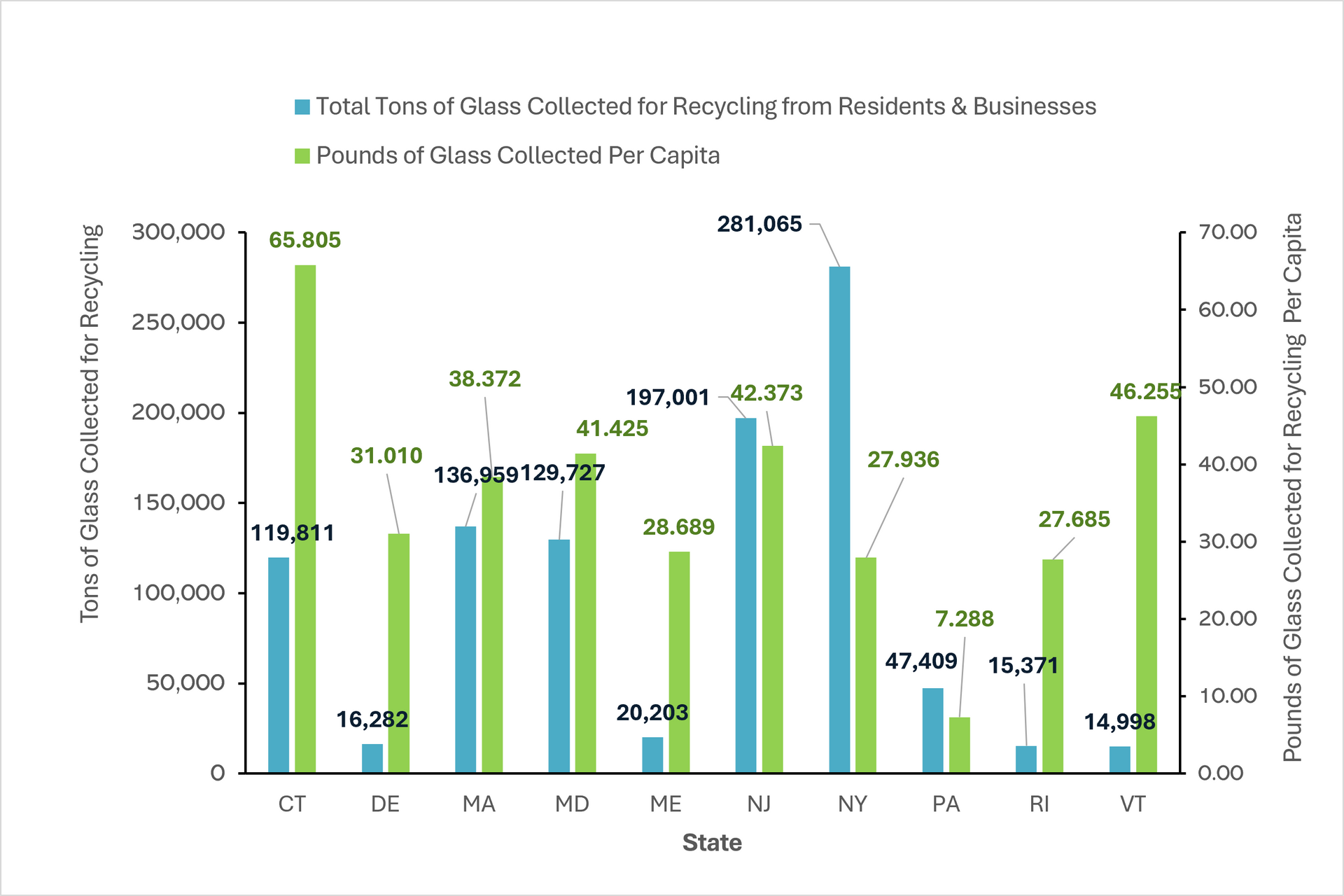
- Connecticut led the region in per capita glass collection at 65.8 pounds per resident.
- New York collected the greatest total tonnage of glass containers for recycling at 281,065 tons annually.
- Five Northeast states operate deposit return systems that include glass beverage containers.
- All Northeast states provide residents access to curbside and/or drop-off recycling programs.
- Reporting methodologies vary significantly among states, affecting direct comparisons of recycling performance.
- Recycled glass supports multiple end markets, including new containers, fiberglass, concrete applications, and aggregate products.
"Glass is one of the few packaging materials that can be recycled repeatedly with minimal loss of quality," said Megan Schulz-Fontes, Executive Director of NERC. "The data show that strong collection systems and supportive policies can significantly increase glass recovery and create valuable feedstock for manufacturers."
Among the report's key findings, Vermont and Connecticut achieved the highest rates of glass container recovery relative to total glass container waste generated, recycling an estimated 79.9% and 77.0%, respectively. Both states operate deposit return systems that include glass beverage containers and ranked among the region's leaders in per capita glass collection.
“Glass bottles and jars have been banned from the trash in Vermont since 2015 and we have had a Bottle Bill since the 1970s," said Matt Chapman, Director, Vermont DEC Waste Management and Prevention Division. "We’re glad to see that our glass container recovery rate reflects Vermonters’ commitment to recycling.”
The report found that New York collected the largest total tonnage of glass containers for recycling at more than 281,000 tons annually, followed by New Jersey at approximately 197,000 tons.
The findings demonstrate that opportunities exist across the region to increase glass recovery through improved collection systems, stronger processing infrastructure, and continued end-market development.
The analysis also revealed substantial variation in state reporting methodologies, recycling requirements, and collection systems. While all Northeast states provide residents with access to curbside and/or drop-off recycling programs, collection models differ considerably. Five states operate deposit return systems, several offer source-separated glass drop-off programs, and Pennsylvania is the only state identified as providing source-separated curbside glass collection in select communities.
These differences present challenges when comparing data across states and highlight the need for continued efforts to improve reporting consistency and transparency.
The report notes that recycled glass serves a growing number of end markets, including new glass containers, fiberglass insulation, pozzolan for concrete, foam glass aggregate, and other construction applications. Many of these markets require high-quality glass cullet with low contamination levels, making effective collection and processing systems essential.
Although glass is heavier than many alternative packaging materials and can be more transportation-intensive when moved long distances, increasing local and regional collection, cleaning, and processing capacity can improve environmental outcomes. Recycled glass can help reduce greenhouse gas emissions associated with manufacturing by replacing virgin raw materials and supporting a more circular economy.
The findings suggest that strategic investments in collection systems, processing infrastructure, and end-market development could increase glass recovery rates throughout the Northeast while supporting resource conservation, economic development, and reductions in greenhouse gas emissions.
The Northeast Flow of Glass Report was developed by NERC's Glass Committee with support from state agencies, industry partners, and stakeholders across the region. The report examines consumer glass containers, including food and beverage bottles and jars, as well as non-food glass containers.
The full report is available at https://www.nerc.org/glass-reports.
About NERC
The Northeast Recycling Council, Inc. (NERC) is a multi-state nonprofit organization committed to minimizing waste, conserving natural resources, and advancing a sustainable economy through collaboration and action. NERC's eleven member states and advisory members work together to address sustainable materials management challenges and promote solutions across the Northeast region.
Share Post