
Microplastics: The What, Where, Why And Impact

August 23, 2023

Today's guest blog is authored by Craig Coker is a Senior Editor at BioCycle CONNECT and a Principal at Coker Composting and Consulting near Roanoke VA. The original post can be read here.

Among the organics recycling challenges du jour is the potential presence of microplastics in compost and digestate. Two-part article series starts with an overview and ends with findings of current research. Part I


Food waste disposal bans have been implemented in four states (New York, Massachusetts, Rhode Island and Vermont) and diversion requirements are established in six others (California, Oregon, Washington, Connecticut, New Jersey and Maryland). There are also food waste landfill bans and/or diversion policies in a number of communities (San Antonio TX, Boulder CO, Hennepin County MN, Seattle WA and New York City). The oldest of these diversion requirements is in Vermont, which passed its Universal Recycling Law in 2012 and which covers both commercial and residential sources of food wastes.


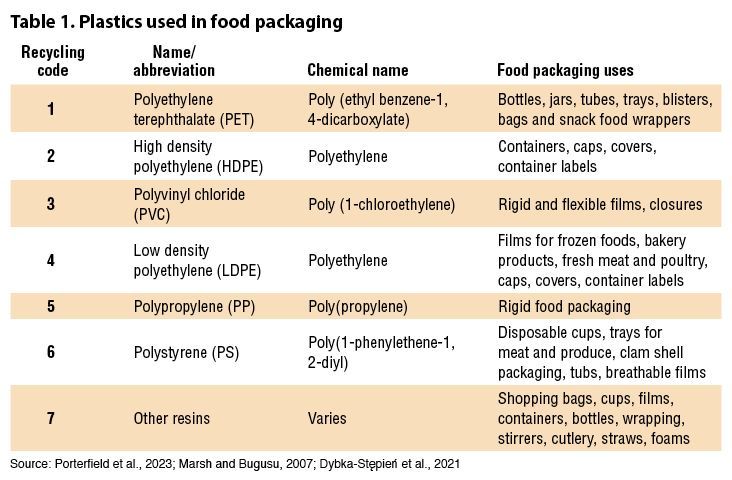
Over the past 10 years, the organics recycling industry (which includes composting, anaerobic digestion, and diversion to animal feed) has come to recognize that plastics contamination from food packaging is a significant challenge to the implementation and growth of these diversion practices. Plastic packaging is ubiquitous in


the American food distribution system. Many different types of plastics are used in food packaging, as shown in Table 1.
Recovering packaged food wastes for reuse or recycling requires either mechanical depackagers or human labor for source separation, both of which are likely to achieve variable and imperfect separation efficiency (do Carmo Precci Lopes et al., 2019; Edwards et al., 2018). Depackaged and source separated food wastes may contain missorted plastic packaging with varying levels of contamination (Porterfield et al., 2023). Plastic contamination in organics recycling — especially in food waste feedstocks — has led to concerns about microplastics.


What Are Microplastics?

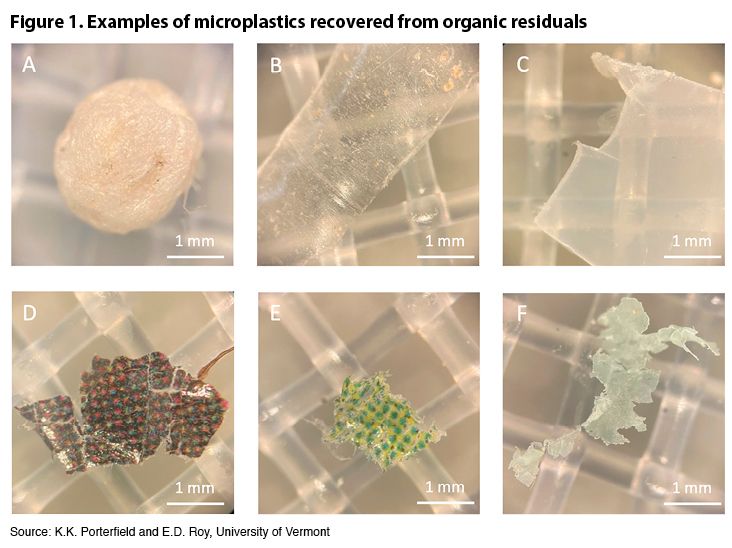
Microplastics (MPs) are small plastic fragments that are less than 5 millimeters (mm) in size — slightly larger than one-eighth inch. A subcategory of microplastics is nanoplastics, synthetic polymers with dimensions ranging from 1 nanometer (nm) to 1 micrometer (μm). For perspective, a compost bacterium is about 1,000 nanometers in size and the width of a single human hair is 20 to 200 μm. Examples of MPs are shown in Figure 1.
There is no consensus on the definition of nano and microplastic particles in relation to human health (Vose, 2022). MPs are directly released to the environment or secondarily derived from plastic disintegration in the environment (Lai, 2022). In a 2021 Spanish study, five polymers represented 94% of the plastic items found in the organic fraction of municipal solid waste: polyethylene, polystyrene, polyester, polypropylene, polyvinyl chloride, and acrylic polymers in order of abundance. Polyethylene was more abundant in films, polystyrene in fragments, polypropylene in filaments, and fibers were dominated by polyester (Edo, 2022).


How Are Microplastics Formed?

MPs can be introduced to agricultural soils through products engineered to be small, such as plastic-coated controlled release fertilizers, treated seeds, and capsule suspension plant protection products. They can be introduced via plastic mulching, contaminated soil amendments, irrigation water, atmospheric deposition, roads and litter (Porterfield et al., 2023 and citations within).

MPs can also be formed during and as a result of food waste depackaging, a separation process. In its simplest form, separation is a binary process, splitting a feed material into two components. These components could be called the extract (or that which you are trying to recover) and the reject (that which you do not want). The objective of a binary materials separator is to split a feed material into two different components by exploiting some difference in the material’s properties.


Separation of materials requires identifying the appropriate characteristic by which separation can be done — or what material property will be exploited to achieve separation. This could be called the “code,” or signal, to tell a machine how to separate materials. The ability of a human or a machine to identify a property’s characteristic and to perform some function, actively or passively, on that material as a result of that information could be called “switching,” or separating the material according to that characteristic (Vesilind, 1984). For example, depackaging commingled food wastes uses density as a code and can use force as a switch to separate packaging, then uses compressive strength (hardness) as a code and pressure as a switch to push organics through an extrusion plate or separator screen.


Depackaging source separated food wastes is very labor-intensive if done by humans. As a result, a number of depackaging equipment systems have come to the U.S. organics recycling market (Coker, 2019; Coker, 2021). The methods used to separate foods from their packages include extrusion (similar to how pasta and ground meat are made), vertical hammermills (force applied against a vertical punch-plate screen), horizontal paddle separators (squeezing the packaging between paddle and containment shell), and centrifugal force separators. There are no data available on which depackaging methods produce MPs or in what quantities, but it is reasonable to assume that machines exerting more force on packaged foods risk higher production of MPs due to shattering of brittle plastics like some high-density polyethylene (HDPE ) and polypropylene.


Health Effects of Microplastics

The research on the health effects of microplastics has focused, to date, on direct exposure. MPs in composts and digestates used as soil amendments are a secondary pathway of exposure, which has not yet been studied to any extent.


Inhalation and ingestion are the two primary routes of exposure to MPs. Inhalation causes physical damage to the lungs and ingestion is thought to have potential impacts on the immune system, liver, energy metabolism and reproduction. There are no comprehensive studies of MPs in the diet, although MPs have been found in seafood/fish, salt, beer, honey, milk, rice, sugar and seaweed (Vose, 2022).


In 2019, the World Health Organization (WHO) commissioned a report to evaluate the evidence of risks to human health associated with exposure to nano and microplastic particles (NMP) in drinking water. A key observation is that MPs are ubiquitous in the environment and have been detected in environmental media with direct relevance for human exposure, including air, dust, water, food and beverages.


There is increasing awareness of the occurrence of MPs in air and their implications for human health. Studies of the inhalation of MPs should include consideration of their biokinetics, as their intake depends on their size, shape, density and surface chemistry, which influence their deposition in the alveolar regions of the lungs. Better characterization is needed of the properties of MPs in air, such as the fractions that contribute to airborne particulate matter and their absolute concentrations. The current lack of such data limits characterization and quantification of the impact of human inhalation of MPs.


Ingestion of MP has been reported in a variety of foods and beverages. An assessment of overall human exposure to MPs is complicated by the limited availability of data on the occurrence of MPs measuring <10 μm in water, food and beverages. Observations from particle and fiber toxicology indicate that particles <10 μm are probably taken up biologically. Most of the available studies on the occurrence of MPs in water, food and beverages reported particles measuring >10 μm, which are unlikely to be absorbed or taken up.


The WHO assessed the quality, reliability and relevance of data on both exposure and effects for their possible contribution to a risk assessment of MPs. The assessment scores indicated that the available data are of only very limited use. Several shortcomings were identified, the most important of which was the heterogeneity of the methods used. It is recommended that standard methods be developed and adopted to ensure that the research community can reduce uncertainties, strengthen overall scientific understanding and provide more robust data for assessing the risks of human exposure to NMPs (WHO, 2022).


Environmental Effects of Microplastics

MPs are categorized as emerging persistent pollutants that occur widely in various ecosystems. MP measurements reported in the literature are 10’s to 1,000’s of particles per dry kilogram of agricultural soils, similar to levels found in composts and digestates (Porterfield et al., 2023). Microplastics in soils have been found to increase soil aeration, water repellence and porosity but to decrease soil bulk density and aggregate sizes (e.g., de Souza Machado et al., 2018b, 2019; Kim et al., 2021; Qi et al., 2020).


MPs’ impacts on terrestrial plants (particularly crops) are poorly understood. Given the persistence and widespread distribution of MPs in the soil, they have potential impacts on terrestrial plants (Wang et al., 2022). Due to their small size and high adsorption capacity, MPs can adhere to the surfaces of seeds and roots, and thus inhibit seed germination, root elongation, and absorption of water and nutrients, and ultimately inhibit plant growth. MPs, especially nanoplastics, can be absorbed by roots, and be moved to stems, leaves, and fruits. The adherence and accumulation of MPs can induce oxidative stress, a complex chemical and physiological phenomenon that occurs in higher plants (vascular) and develops as a result of overproduction and accumulation of reactive oxygen species. They also can induce toxicity to plant cells and to genetic material in plants, leading to a series of changes in plant growth, mineral nutrition, photosynthesis, toxic accumulation, and metabolites in plants tissues. Overall, the phytotoxicity of MPs varies dependent on their polymer type, size, dose and shape, plant tolerance, and exposure conditions. The accumulation of MPs and subsequent damage in plants may further affect crop productivity, and food safety and quality, causing potential health risks (Wang et al., 2022).


Soil microorganisms can be affected by MPs. There are effects on species dominance, diversity and richness reported in the literature (e.g., Blöcker et al., 2020; Fei et al., 2020; Ren et al., 2020) and MPs have been found to cause oxidative stress and abnormal gene expression in earthworms (which can consume and transport MPs) (Cheng et al., 2020).


Even compostable plastics can be a source of MPs. Not all certified compostable packaging fully composts in all facilities due to variability in the technologies and processes used at each facility (USEPA, 2021). The European compostable plastics standard (EN 13432) defines a material as compostable, if 90% (by weight) of the material is fragmented (disintegrated) into particles <2 mm, i.e., below the limit at which particles “count,” after 12 weeks of standardized composting and fully mineralized by 90% within 6 months. The remaining 10% may be transformed into biomass or simply be fragmented into microplastic (Steiner, 2022).


Disclaimer: Guest blogs represent the opinion of the writers and may not reflect the policy or position of the Northeast Recycling Council, Inc.


Share Post

By Brian Shane | OC Today-Dispatch April 30, 2026
(May 1, 2026) Worcester County collected millions more pounds of recycling last year, but generated less revenue – and taxpayers are covering the difference. The shift reflects a sharp drop in the market for recyclable materials, which has undercut what the county can earn from selling paper, plastic and metal. County officials say they sometimes hold materials for weeks or months, waiting for a buyer, Public Works Director Dallas Baker told the county commissioners. “Cardboard still sells really well. Metals sell really well. Plastic is kind of horrible,” he said at an April 14 budget work session. “For most of the year, plastic might not sell at all – like, you have to pay somebody to come take your plastic.” The county is projecting $150,000 in recycling revenue for fiscal year 2027, against more than $1.2 million in costs – a shortfall absorbed by the county’s general fund, according to Enterprise Fund Controller Quinn Dittrich. He added that recycling revenue has declined in the last two fiscal years, falling about $80,000 in 2024 and $15,000 in 2025. Low prices for plastics are driving the decline, according to Bob Keenan, the county’s recycling manager. Vendors are offering just a few cents per pound for plastic. “There is simply no market in it,” he said. “There are warehouses and warehouses of plastic that (vendors) can’t get anybody to buy.” Other materials have also lost value, Keenan said: Corrugated cardboard has fallen from $125 a ton to as low as $60. Mixed paper has dropped from $120 a ton to $70. Aluminum sells for $1.09 by the ton through a broker, though market prices are closer to 80 cents. At the same time, recycling volume is up. Last year, the county collected 1,985 more tons of recyclables – that’s almost 4 million pounds – than in 2024. Totals for 2025 came to 12,236 tons for residential recyclables and 24,707 for commercial, according to Keenan. He noted that the county has been promoting recycling through outreach, in part by hosting 14 school field trips in the last year to its Newark processing facility. “We send them home with a lot of literature about what you can and can’t recycle,” Keenan said. “I want people to know what we do, and that we’re not throwing their recycling away.” Worcester’s revenue decline mirrors a broader trend. A March 2026 report from the Northeast Recycling Council found recycling commodity values hit a five-year low in 12 states, including Maryland and Delaware. Industry reports also show at least five U.S. plastic recycling facilities have closed since early 2025 as demand has weakened. Ocean City officials faced a similar reality years ago. The resort pulled the plug on its traditional recycling program in 2009 after determining it was too costly to maintain. In its final year, the city spent $1.2 million on recycling and brought in $200,000 in revenue, according to Public Works Director Hal Adkins. Since then, Ocean City has contracted to truck its rubbish to waste-to-energy incinerators outside Philadelphia and Washington, D.C. “It was just not sustainable,” Adkins said. “It doesn’t make money.” Read on OC Today-Dispatch.
By Cole Rosengren | WasteDrive April 29, 2026
A combination of EPA and USDA funding has resulted in numerous changes throughout the city, including free commercial recycling service, residential recycling carts and organics infrastructure. Providence, Rhode Island, is starting to see tangible results from multiple organics and recycling programs funded by federal grants. This work was spurred by $3.34 million from the U.S. EPA’s Solid Waste Infrastructure for Recycling grant program awarded in 2023, as well as $255,850 from a U.S. Department of Agriculture grant awarded in 2024. Now, multiple years in, the city has funded new vehicles, carts and other infrastructure. Back in November 2023, Mayor Brett Smiley described the EPA funding as a big opportunity to advance sustainability efforts. “By helping divert food waste, in particular, from the waste stream we can extend the life of our Central Landfill, but also help meet our climate justice goals,” he said at a November 2023 Northeast Recycling Council event. Smiley noted this would also help address recycling issues. “We know that we’ve got a major education gap to fill with residents and business owners. The recycling rates in the city of Providence are quite low [and] there’s a very clear equity gap in terms of which neighborhoods recycle and how.” Commercial recycling One unique aspect of Providence’s grant-funded programs is free commercial recycling service, which is still coming to fruition. In his NERC speech, Mayor Smiley noted this idea was driven in part by “a problem with overflowing dumpsters” that “degrades the quality of life” in certain commercial areas with a lot of restaurants. The SWIFR grant, which has funding until January 2027, helped fund the purchase of a rearload recycling collection truck for approximately $200,000. This truck is run by the city’s Department of Public Works and initially focused on offering free service in two neighborhoods. Federal Hill and the West End were chosen for their high density and proliferation of restaurants. Participants can receive two to three carts, which will be collected twice per week. The Center for EcoTechnology is helping manage the outreach and technical assistance for this as well as a separate technical assistance program for commercial organics. Kevin Proft, Providence’s deputy director of sustainability, said in a recent interview there was a long lead time to procure the truck and progress has been slower than hoped. The city’s goal was to recruit up to 75 businesses, but so far about 10 had signed on as of early April. This is yielding an estimated half a ton to 1 ton per week. “Surprisingly, we haven’t been able to get businesses to jump at the opportunity as easily as we thought we would,” said Proft, adding the pitch is “it could potentially reduce your hauling costs by reducing the amount of waste in your dumpster.” Lorenzo Macaluso, chief growth officer for CET, said his team is working to create testimonials of participating businesses and plans to continue expanding outreach. The city is also looking at potentially expanding the program to include other neighborhoods. “Sometimes selling a free thing is harder than you think ... what we find is decision makers often need to hear things more than once,” he said. Macaluso also noted some businesses may feel recycling creates extra work, even when technical assistance is available to help with bin setup and signage. “So we’re trying to compress that learning curve as much as possible and give them those tools, but that perception is hard to overcome.” Residential recycling Providence has an estimated 2.4% recycling rate and 47% contamination rate , despite prior goals to reach 30% by 2020 as well as “eliminate contaminated recycling” by 2030 . The city recently began rolling out 55,000 new curbside recycling carts , along with an updated citywide education campaign, in an effort to reverse these trends. This came together with $1.8 million of EPA SWIFR funding, $625,000 from The Recycling Partnership and $5 million in financing from Closed Loop Partners’ Catalytic Capital & Private Credit Group. That latter commitment was backed by American Beverage’s Every Bottle Back initiative. The carts align with a new curbside collection contract awarded to WM last summer. That contract included an amendment stipulating the company pay $50,000 for recycling education in the first year and offer services at that value in the following years. A WM spokesperson confirmed that education funding is managed by the city. Another new aspect of this contract was the inclusion of WM’s Smart Truck camera technology in collection vehicles. This allows for targeted contamination monitoring and education feedback. Keefe Harrison, CEO of The Recycling Partnership, said during a recent interview this would allow for more targeted education efforts and reduce some of the need for manual cart checks or tagging. “We will be able to use cameras in the trucks to identify households that are doing a great job recycling versus the ones that are having a harder time, and then target those ‘oops’ tags for the ones that are having the harder time.” WM confirmed this is the first deployment of its technology in New England, following prior launches in other parts of the country . Proft said data reliability has been inconsistent for certain routes, but was optimistic about its long-term potential. “The sensors are a little bit sensitive and they’ve been breaking ... there seems to be a myriad reasons that we’re struggling to really get that running smoothly,” he said, while noting that “even the data we’re getting now is useful based on the capacity.” “WM is happy to be deploying this new technology in the City of Providence. With any new program there will be an implementation period, but we are pleased with the process so far and are excited about its future,” said Garrett Trierweiler, a regional director of public affairs for WM, via email. Organics In 2019, the city set a goal to “eliminate food waste” by 2040 . The recent federal funding has been used to help boost processing infrastructure, collection and education. Providence dedicated approximately $200,000 of SWIFR funding to support Groundwork Rhode Island’s West End Compost Hub. The site, an in-vessel composting project, is currently under construction and could open later this summer, according to Groundwork. USDA funding also helped cover five new organics drop-off sites managed by Groundwork, raising its total network to 16 sites . On the commercial side, SWIFR funding helped purchase two trucks for Remix Organics, a hauler in the city. This included a unique vacuum truck to collect brewery wastewater, which had become a concern for state regulators due to how it was previously managed. “They had more more customers asking for their service than they could service,” said Proft, describing this as an opportunity to “help our local economy by supporting this local business and also diverting more food waste from the landfill through these big chunks of commercial businesses.” Additionally, USDA funding covered a contract for CET to conduct outreach and education to businesses about organics recycling. This helped line up customers with vendors such as Remix and start collection service at a notable new location, the Rhode Island Convention Center. Other areas covered by the USDA grant included education that led an estimated 350 new households to participate in subscription pickups or free dropoff sites, as well as mentorship for setting up backyard composting at about 60 households. The grant also helped the Rhode Island School Recycling project set up food recovery and organics recycling at multiple elementary schools. Read article on Waste Dive.
By Marissa Heffernan | Packaging Dive April 21, 2026
The Northeast Recycling Council’s PCR Material Demand Hub centralizes resources to help packaging developers and buyers. Dive Brief: The Northeast Recycling Council launched a PCR Material Demand Hub to help companies, whether they make packaging or just purchase it, tap into domestic recycled content markets. The hub includes information on numerous materials commonly used in packaging, including paper, plastic and aluminum. While the main focus is recycled content, there’s also information on waste diversion, reuse, carbon impacts and other life cycle assessment variables. NERC hopes to add to it in the future, including resources for creating contracts. For those newer to PCR purchasing, the hub has a road map for getting started, as well as a Q&A on how to identify and buy plastic products with PCR. The hub draws on work from the Association of Plastic Recyclers in that area. Dive Insight: Companies and organizations looking to buy postconsumer recycled content and help shore up faltering domestic recycling markets have a new place to go for support. The Northeast Recycling Council launched the PCR Material Demand Hub to help counteract the recent strain on recycling markets as some brands loosen recycled content goals and resin imports surge . Megan Schulz-Fontes, executive director of the Northeast Recycling Council, said it’s the latest iteration of past programs. “We wanted to create a hub which pools all the resources that NERC had developed historically, as well as new ones that have come about since, to make it easier for organizations, whether they’re private or public, to purchase sustainable materials,” she said. In the past, NERC had worked with APR on the Government Recycling Demand Champions Program, which focused on getting governments, nonprofits and academic institutions to buy recycled materials. By 2022, activity in that program had started to lapse, Schulz-Fontes said. “We had done a lot of outreach. It was my impression that it wasn’t a need as much anymore, because those organizations had established sustainable procurement programs,” she said. However, markets shifted, most notably for PET, and today, we all “see and feel the impacts of processor closures due to the cheaper imports coming in and the chronic oversupply of virgin,” Schulz-Fontes said. There was a need again. As APR relaunched and redesigned the Recycling Demand Champions program and the National Stewardship Action Council started its “Remade in America” pledge, Schulz-Fontes said NERC wanted to support those programs and also reinvigorate some of its own. The Demand Champions Program suggests that organizations commit to PCR use, establish long-term supply agreements and think outside the box by using PCR in non-standard formats. To support those goals, the hub has a directory of manufacturers, vendors and suppliers of a variety of products with recycled content, as well as a Recycled Content and Environmentally Preferable Purchasing Directory with all levels of governmental resources, purchasing specifications and certification standards. That Environmentally Preferable Purchasing Directory is based on work that former NERC Executive Director Lynn Rubinstein did to develop an environmentally preferable purchasing specifications document, which is helpful for those who are just getting started, Schulz-Fontes said. In addition, the hub will link procurement professionals and others working in adjacent roles via an Environmentally Preferable Purchasing Network listserv called EPPnet. That’s also one of NERC’s older programs that needed new life breathed into it, Schulz-Fontes said. “We’re hoping that’s something that’s useful for folks,” she said. Anyone who is working directly on procurement is welcome to reach out to be added to the group. Other directories that NERC’s hub link to are the EcoPaper Database; Intertek’s Sustainability Certification Directory; the Electronic Product Assessment Tool; SCS Global Services Certified Green Products Guide; EPA’s CPG Product Supplier Directory; and APR’s Buyers and Sellers Directory. Read the article on Packaging Dive.