
Q1 2026 Northeast Commodity Values Increase Despite PET’s Continuing Decline

Megan Fontes • May 26, 2026

Aluminum, Clear Glass, and Natural HDPE See Significant Gains in Outbound Tons Marketed in 2025
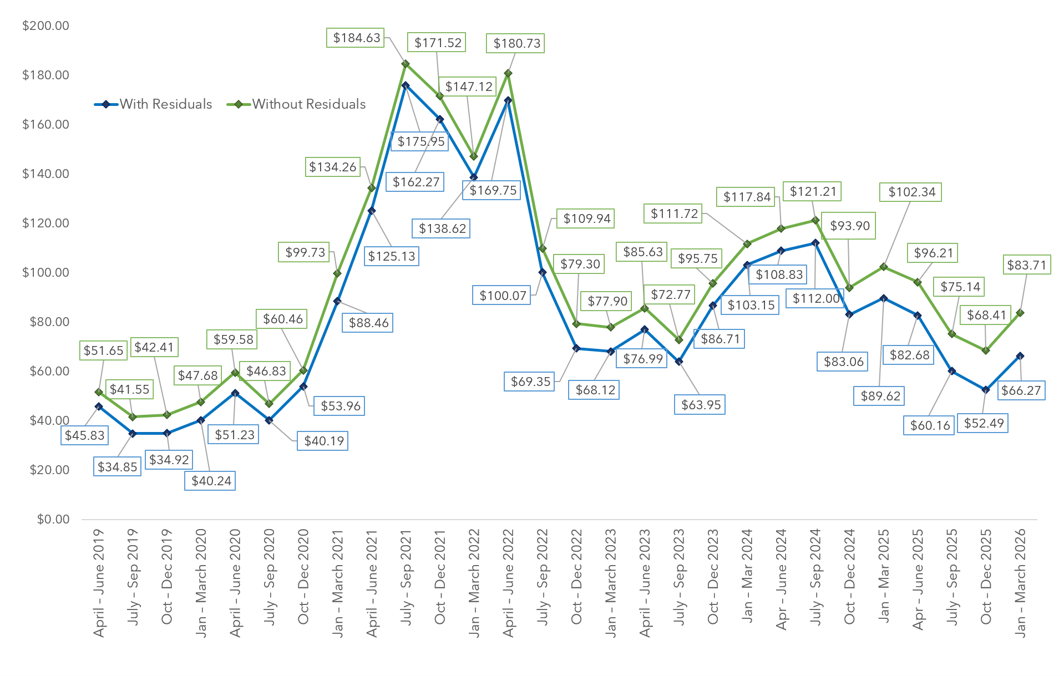
The average blended commodity value increased significantly in Q1 2026 compared to Q4 2025, rising 22.37% without residuals and 26.26% with residuals. Single stream values increased by 21.01% to $81.28 per ton without residuals and by 28.71% to $67.11 per ton with residuals. Dual stream values increased by 23.83% to $91.31 per ton without residuals and by 15.97% to $63.60 per ton with residuals.


NERC’s Material Recovery Facilities (MRF) Commodity Values Survey Report for January–March 2026 reflects strengthening commodity values across the Northeast after several quarters of decline. Dual stream/source-separated MRFs continued to report higher average commodity values than single stream MRFs on a non-residual basis.


Individual commodities had higher prices during the quarter, except for Polyethylene Terephthalate (PET), All Other Paper, and Brown Glass. Residue costs also increased during the quarter, making disposal more expensive. Participating MRFs may calculate residue costs differently.


The annual material percent composition update show an increase in the marketed outbound tonnages of clear glass containers, aluminum cans, and natural HDPE. Offsetting decreases included PET and polypropylene.


This is the 28th quarterly report in NERC’s ongoing series examining the market value of commodities marketed by MRFs in the Northeast. The report includes data from 19 MRFs representing twelve states: Connecticut, Delaware, Maine, Maryland, Massachusetts, New Hampshire, New Jersey, New York, Pennsylvania, Rhode Island, Vermont, and Virginia.


These survey results reflect the varying laws and collection systems among participating states. Five of the states included in the report have beverage container deposit laws, resulting in fewer glass bottles, PET bottles, and aluminum cans being processed at MRFs in those states. Consequently, those facilities are likely to generate less revenue from those materials.


The report also reflects a mix of single stream, dual stream, and source-separated recycling systems, with single stream remaining the most common collection approach. Collection method impacts both MRF design and operations, meaning the data reflects the unique blend of facility types, statewide policies, and market access across the reporting region.


Residual refers to incoming material that cannot be marketed and must be disposed of. Values reported without residuals reflect the value of a perfect ton of marketed material, while values reported with residuals reflect the value of each ton processed after accounting for disposal costs associated with unmarketable material. In many cases, recovered glass is marketed at a negative value.


This data is not intended to serve as a price guide for MRF contracts. NERC’s database includes both single and dual stream MRFs, states with and without beverage container deposit laws, varying geographic access to markets, and differing material collection programs. As a result, the report reflects a broad diversity of operating conditions and should not be used as a pricing benchmark for any specific recycling program.


For more information, contact Megan Schulz-Fontes, Executive Director, at megan@nerc.org.

Share Post

By Sophie Leone June 9, 2026
Rowan University, located in Glassboro New Jersey, was founded in 1923 and has since evolved into a public research institution that is ranked among the top 100 in the nation. As a fast-growing institution, Rowan is committed to high-quality affordable education. Rowan offers over 100 bachelor's programs and has 15 colleges and schools for students to specialize in their degrees. Rowan also has multiple institutes and center specializing in a plethora of multiple areas of study. One such institute is its Advanced Materials & Manufacturing Institute (AMMI) where cutting edge science and engineering is occurring to improve upon materials and the processes with which we make, utilize, and reuse them. AMMI was founded by Dr. Joe Stanzione, Professor of Chemical Engineering at Rowan. Dr. Stanzione recently received a two-year New Jersey DEP grant which would expand the university's glass recycling effort. The goal of this two-year project is to “grow the recently established Glass Education, Research, and Recirculation Program (GERRP) that is a partnership between Rowan's Advanced Materials & Manufacturing Institute (AMMI) and Bottle Underground.” GERRP works to recirculate waste glass and connect end-users on Rowans' campus and the surrounding local economy to the supply. “With its rich history in innovative glass science and revolutionary glass manufacturing, it makes sense to explore, implement, and grow game-changing glass recirculation strategies in Southern New Jersey, strategies that we hope can be emulated regionally and adopted globally,” states Joe Stanzione. NERC is excited to welcome Rowan University and the Advanced Materials & Manufacturing Institute to our growing academic community. We look forward to supporting their efforts in the glass industry. For more information on the Advanced Materials & Manufacturing Institute (AMMI) at Rowan University visit.
By Sophie Leone May 27, 2026
Founded by Cynthia Andela, Andela Products is a leader in Glass Recycling. Since its inception, Andela Products has expanded into designing complete systems to pulverize, clean and screen post-consumer waste glass. Andela uses cost-effective systems to transform waste glass into usable, high-value materials. Andela provides multiple applications such as a Pulverizer, Crusher, Laminated Glass, CleanGlass Cleaup Systems, and Single Stream Recycling. The variety in systems allows Andela to reach a diverse network of businesses and expand their reach. In addition to equipment, Andela has a detailed library of resources and safety information on the recycled glass market. Providing the community, and those in the industry, with details on glassphalt, sand and aggregates, glass sand as soil amendments, PCR, best practices and much more. Andela features testimonials on their websites, showcasing the prestige and easy operational use of their equipment by customers. With some customers stating, “We are incredibly satisfied with the GP-MegaMini from Andela Products — it is efficient, reliable, and its performance has exceeded our expectations” and “We appreciate the ease of ordering wear parts and value the attention and service we receive from Andela Products, it’s a true partnership”. NERC is excited to welcome Andela Products into our growing glass community. We look forward to supporting an organization committed to innovation and advancing technology while promoting education and best practices. For more information on Andela Products visit.
By Brian Shane | OC Today-Dispatch April 30, 2026
(May 1, 2026) Worcester County collected millions more pounds of recycling last year, but generated less revenue – and taxpayers are covering the difference. The shift reflects a sharp drop in the market for recyclable materials, which has undercut what the county can earn from selling paper, plastic and metal. County officials say they sometimes hold materials for weeks or months, waiting for a buyer, Public Works Director Dallas Baker told the county commissioners. “Cardboard still sells really well. Metals sell really well. Plastic is kind of horrible,” he said at an April 14 budget work session. “For most of the year, plastic might not sell at all – like, you have to pay somebody to come take your plastic.” The county is projecting $150,000 in recycling revenue for fiscal year 2027, against more than $1.2 million in costs – a shortfall absorbed by the county’s general fund, according to Enterprise Fund Controller Quinn Dittrich. He added that recycling revenue has declined in the last two fiscal years, falling about $80,000 in 2024 and $15,000 in 2025. Low prices for plastics are driving the decline, according to Bob Keenan, the county’s recycling manager. Vendors are offering just a few cents per pound for plastic. “There is simply no market in it,” he said. “There are warehouses and warehouses of plastic that (vendors) can’t get anybody to buy.” Other materials have also lost value, Keenan said: Corrugated cardboard has fallen from $125 a ton to as low as $60. Mixed paper has dropped from $120 a ton to $70. Aluminum sells for $1.09 by the ton through a broker, though market prices are closer to 80 cents. At the same time, recycling volume is up. Last year, the county collected 1,985 more tons of recyclables – that’s almost 4 million pounds – than in 2024. Totals for 2025 came to 12,236 tons for residential recyclables and 24,707 for commercial, according to Keenan. He noted that the county has been promoting recycling through outreach, in part by hosting 14 school field trips in the last year to its Newark processing facility. “We send them home with a lot of literature about what you can and can’t recycle,” Keenan said. “I want people to know what we do, and that we’re not throwing their recycling away.” Worcester’s revenue decline mirrors a broader trend. A March 2026 report from the Northeast Recycling Council found recycling commodity values hit a five-year low in 12 states, including Maryland and Delaware. Industry reports also show at least five U.S. plastic recycling facilities have closed since early 2025 as demand has weakened. Ocean City officials faced a similar reality years ago. The resort pulled the plug on its traditional recycling program in 2009 after determining it was too costly to maintain. In its final year, the city spent $1.2 million on recycling and brought in $200,000 in revenue, according to Public Works Director Hal Adkins. Since then, Ocean City has contracted to truck its rubbish to waste-to-energy incinerators outside Philadelphia and Washington, D.C. “It was just not sustainable,” Adkins said. “It doesn’t make money.” Read on OC Today-Dispatch.